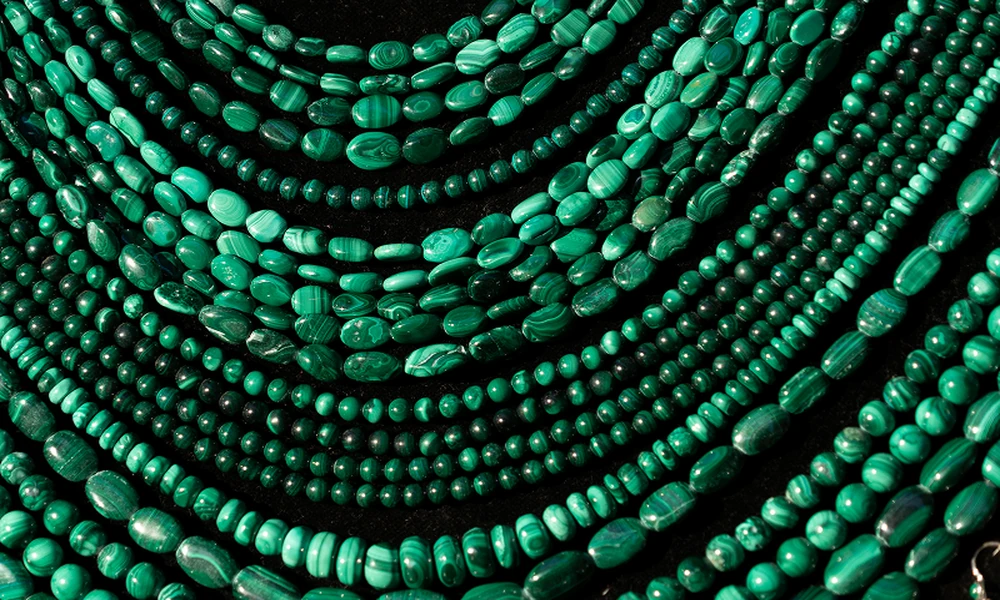
A jadeite necklace made of forty matching beads can cost more than a single pendant carved from a noticeably bigger piece of stone. That surprises most first-time buyers, who reasonably assume a bigger single piece should always cost more than several small ones. The reason has less to do with size and more to do with something far harder to pull off.
What Actually Makes Bead-Matching So Difficult
A single jadeite pendant only has to look good on its own, carved from whichever section of a rough stone shows the best colour and clearest translucency. A jadeite necklace demands something much harder: enough beads cut from the same piece, or carefully matched across several pieces, to share a consistent colour, translucency, and texture all the way around the strand. Jadeite forms with natural colour zoning inside a single rough stone, meaning most of it simply isn’t uniform enough to produce even a dozen matching beads, let alone the thirty or forty a full necklace typically needs.
Why a Slight Mismatch Is Easier to Spot Than People Expect
Jadeite’s colour sits close enough to the surface that even a subtle shift between beads becomes obvious once they’re strung together and seen as a continuous line rather than one isolated piece. A pendant’s imperfections can sometimes be angled away from view or balanced out by its setting; a necklace has nowhere to hide a bead that’s slightly paler, more opaque, or a shade warmer than its neighbours. That visibility is part of why a well-matched strand is treated as a mark of real skill in sourcing and cutting, not just a longer, more tedious version of making a pendant.
What to Actually Look at When Comparing Necklaces
Side-by-side comparison is where a jade shop in Singapore with real sourcing experience tends to show its value, since spotting a subtle mismatch takes a trained eye more than a well-lit counter. A few things are worth checking directly:
- Hold the strand under consistent lighting and check whether colour shifts noticeably from one end to the other.
- Look at translucency bead by bead rather than judging the strand as a single average impression.
- Check that bead sizes taper or stay consistent deliberately, not as a result of mismatched sourcing.
- Ask whether the strand is cut from a single rough stone or assembled from separately matched material.
Styling a Strand Once the Matching Is Settled
Once a strand’s quality is settled, how it actually gets worn tends to come down to length and bead size rather than anything to do with grading. A shorter, tighter strand sits close to the collarbone and reads more formal, while a longer rope-length strand can be worn loose or doubled for a more casual look. Smaller beads tend to suit everyday wear under a collar, while larger beads make more sense as a standalone statement piece for an occasion where it’s meant to be seen clearly.
Clasp choice tends to get overlooked in all of this, even though it affects how often a strand actually gets worn. A clasp that’s fiddly to close one-handed often means a beautiful necklace spends more time in its box than around a neck, while a well-designed clasp disappears into the strand visually without making the piece harder to put on. It’s a small detail compared to bead matching, but it’s often the difference between a necklace that’s worn often and one that’s saved for special occasions only.
Before Comparing Two Strands Side by Side
- Price differences between two similar-looking necklaces are usually explained by matching quality, not just size or carat weight.
- A strand cut from one rough stone will typically cost more than one assembled from separately sourced beads, even if the colour looks similar at a glance.
- Certification for Type A, untreated jadeite is worth asking for on a necklace just as much as on a single pendant.
A jadeite necklace rewards patience in a way a single pendant doesn’t ask for, both from whoever sourced and matched the beads, and from whoever’s comparing two strands trying to work out why one costs so much more than the other. Once that’s understood, the price difference stops looking confusing and starts looking like exactly what it is.
Seeing how consistently a strand’s beads actually match is something a photo rarely shows accurately. Contact Gen.K Jewelry to compare a few in person.